How Speech Therapy Helps Correct Common Speech Sound Errors
When a kid utters “wabbit” instead of “rabbit” or “thoap” instead of “soap,” it may sound nice in the initial stage, but if it’s continued for a long period of time, it could be an indication of speech difficulty that needs professional attention.
Many children often face difficulties while learning to speak. Although not every error requires attention, if it starts affecting communication, confidence, learning, and social interactions, this is where misarticulation speech therapy becomes valuable. It becomes helpful to learn the correct way to produce speech sounds, making communication smoother and more understandable.
In this guide, we’ll explore common speech sound errors, why they happen, and how speech therapy helps children improve their pronunciation in a fun, supportive, and effective way.
What Is a Speech Sound Disorder?
When a kid faces difficulty while producing sounds correctly, instead of saying words clearly, they may replace, leave out, add, or change certain sounds, known as Speech Sound Disorder.
This is the most common disorder among children. They may make one sound or several sounds, which totally depends on their age and development.
Children with speech sound disorders usually understand language well, but expressing themselves clearly becomes difficult because of incorrect sound production.
Understanding Articulation Disorder
When a child can’t utter a specific speech sound due to incorrect tongue, lip, jaw, or mouth movements.
For example:
- ‘Dog’ becomes “Fog”
- “Cat” becomes “Fat”
- “Spoon” becomes “Poon”
These pronunciations are not always intentional; kids may not simply understand where to place their tongue while speaking. Early therapy helps children develop clearer speech before these habits become permanent.
Common Speech Sound Errors in Children
Every child has different speech problems, and some mistakes are more common than others.
1. Sound Substitution
When one sound is replaced with another.
Examples:
- Cat → Bat
- Moon→ Soon
- Rabbit → Wabbit
This is one of the most common pronunciation mistakes seen in young children.
2. Sound Omission
When the child leaves one sound from a word.
Example:
- School→Cool
- Rat→At
- Spoon→Poon
3. Sound Distortion
The child attempts the correct sound but produces it incorrectly.
A common example is a lisp, where the “S” or “Z” sound comes out with the tongue between the teeth.
4. Sound Addition
Sometimes insert new letters into a word.
Example:
- Blue→Baloo
- School→Iskool
Why Do These Speech Errors Happen?
- Delayed development in speech
- Autism Spectrum Disorder
- Down syndrome
- Neurological Problems
- Family history of speech delays
Sometimes the exact cause cannot be identified, but therapy still provides excellent improvement.
Signs Your Child May Need Speech Therapy
Parents should watch for signs such as:
- Finding difficulties while saying words according to their age.
- Facing problems understanding a child’s words
- Facing problems in pronunciation
- Becoming frustrated while speaking
Early assessment makes treatment easier and more successful.
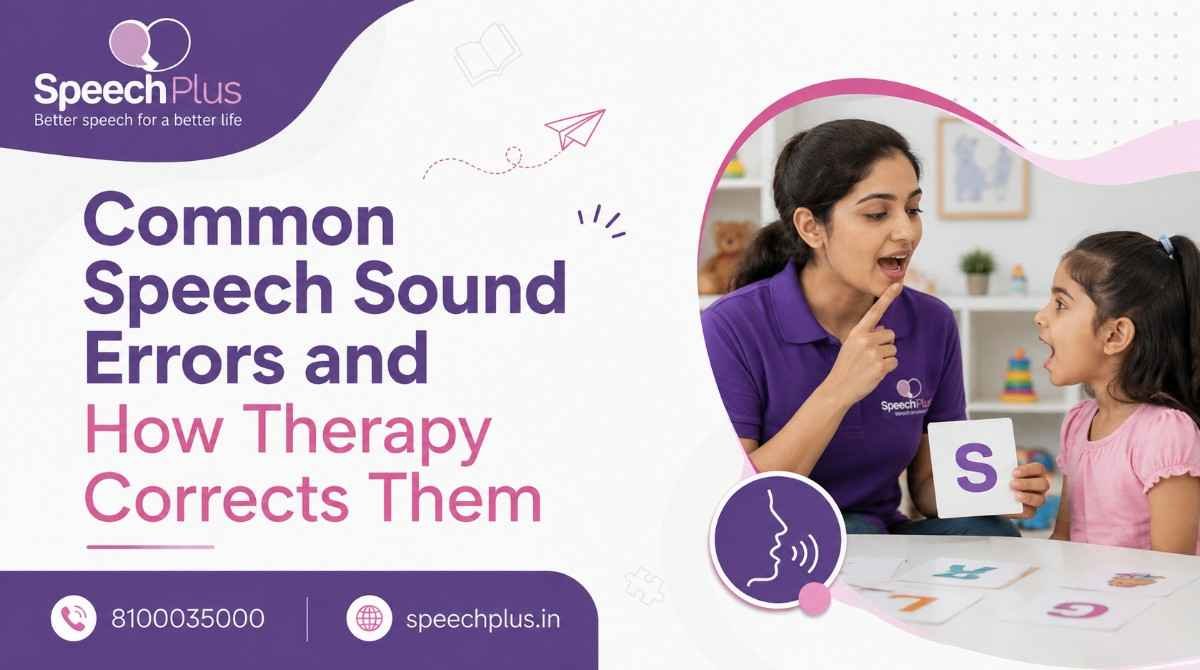
How Misarticulation Speech Therapy Works
There’s always a personalised approach to treat these misarticulation problems in little ones.
Speech Assessment
Therapists first evaluate the problems in the child’s speech pattern, sound errors, and oral movements to identify the exact difficulty.
Teaching Correct Sound Production
After proper evaluation, children learn the proper use of the tongue, lips, and jaw to produce different sounds.
Everyday Practice
‘Practice makes a man perfect’ is not just a proverb; through proper practice during conversations, storytelling, and classroom activities to build confidence.
Benefits of Early Speech Therapy
Starting early speech therapy can be beneficial in many ways. It can make speech clearer, help with better pronunciation, improve communication skills, help to build confidence, etc. Children usually make faster progress when therapy begins before incorrect speech habits become permanent.
Final Thoughts
Mistakes in speech are common in children, but prolonged mispronunciation shouldn’t be ignored. Whether your child has an articulation disorder or another speech sound disorder, early intervention can make a lasting difference.
With professional misarticulation speech therapy, personalised guidance, and regular speech exercises, children can develop clearer speech, communicate confidently, and express themselves with ease. The sooner therapy begins, the greater the opportunity for long-term success.