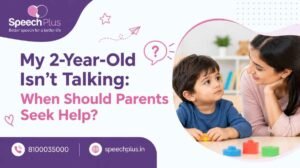

Speech Delay in Children: When Should Parents Seek Speech Therapy?
Children grow and learn at their own pace, with some developing specific skills earlier than others. However, it’s vital to check whether your child is achieving the age-appropriate developmental milestones. For instance, if your child is not saying about 50 unique words or is failing to form 2-word sentences even by the age of 2-3years, it may indicate your child is suffering from speech delay.
Speech delay does not always indicate that there’s something wrong – your child may simply be a late talker. However, it may also indicate other underlying conditions like hearing problems, autism, or other developmental or neurological disorders. Therefore, consult a paediatrician or a speech-language pathologist to identify such underlying causes (if any), so as to start an appropriate speech delay treatment or therapy on time.
What is Speech Delay?
We can define speech as the physical act of producing sounds to say words and form sentences. A toddler or a 2-3-year-old child may exhibit the symptoms of delayed speech if they experience difficulty forming correct sounds to make words and sentences. A speech delay, however, does not include issues with understanding or language comprehension or nonverbal communication.
Besides toddler speech delay, some children may also exhibit language delay, which encompasses challenges with understanding and communicating, including both verbal and nonverbal communication. A child with language delay may be able to make sounds and pronounce some words correctly but may face difficulty forming meaningful phrases or sentences. As a result, they may also struggle to understand others.
Know the Developmental Milestones of Your Toddler!
Parents and caregivers must be aware of the critical developmental milestones of toddlers (1-3 years), particularly highlighting their speech and language development.
- 12–18 Months (1 to 1.5 Years): The child should be able to use 3-10 simple words, like ‘mama’, ‘dada/papa’, ‘cat’, ‘ball’, ‘bye-bye’, etc. At this age, the child should also be able to understand simple instructions (such as ‘come here’, ‘clap your hands’, ‘stand up’, etc.), and use hand gestures (like waving, clapping, or pointing) to communicate.
- 18–24 Months (1.5 to 2 years): At this age, the toddler should be able to expand their vocabulary to 20-50 words. They can usually combine 2 simple words to communicate, such as ‘more milk’, ‘give ball’, ‘help me’, ‘mumma come’, etc. Between 1.5 and 2 years, a toddler can also follow simple instructions and engage in pretend play, such as feeding a doll.
- 2–3 Years: By ages 2 and 3, the child should be able to use 300-800+ words and form 2- or 4-word sentences, such as ‘I want cookie’, ‘Give me toy’, ‘Baby is sleeping’, ‘Mama is coming’, etc. They can also understand basic concepts (like up/down, one/many, big/small, etc.) and identify different colours and shapes. By the age of 3, a child can also call themselves and others by name, ask questions, recite nursery rhymes, sing a song, and even tell a story.
If your toddler is not showing these age-appropriate developmental milestones (such as not saying any word by 15-18 months, not making 2-word phrases by 2 years, not making eye contact, or not responding to their name), consider these as red flags that need immediate attention. Consult a professional and certified Speech-Language Pathologist (SLP) to address any speech and language delays at an early age. Although every child learns at their own pace, early intervention and the right speech therapy for kids make a big difference!
Speech Delay at Age 2: When is it a Concern?
Check whether your 2-year-old child is able to follow simple instructions, form simple sentences using the right vocabulary, or use gestures while expressing their wants and needs. The 2-year-old speech delay symptoms may also include not being able to imitate sounds, point out different objects while asking for them, and communicate with parents and peers effectively.
Speech Delay at Age 3: When to Seek Help?
If your 3-year-old is having difficulty forming short sentences or answering simple questions, or has limited vocabulary, it’s high time you seek help from a professional. Other symptoms of a 3-year-old speech delay may include trouble following simple or age-appropriate instructions, problems expressing their own needs and feelings, or saying speech that is hard for others to understand.
Speech Delay at Age 4: Know the Red Flags!
At age 4, a child is generally capable of speaking complete sentences using a wide range of vocabulary, describing events or telling a story, and answering or asking questions confidently. If not, opt for speech therapy at an early stage to ensure age-appropriate speech and language development. Also, check for other speech delay symptoms in your 4-year-old, such as having limited ability to find or use appropriate words or follow multi-step instructions, or saying speech that’s difficult for others to understand, which may lead to frustration while communicating.
Key Takeaway: The Role of Parents and Caregivers
Early intervention is crucial when your child is showing signs of speech or language delay. That’s because the first few years of a child are vital in the proper development of speech, language, and communication skills. Besides opting for speech therapy for kids, parents must also create a positive and supportive learning environment and encourage growth through everyday activities.
For instance, parents and caregivers must read picture books together with their kids and limit passive screen time for them. Parents should give their children time to respond after asking a question and give them the opportunity to express their needs using sounds, words, gestures, visual cues, and facial expressions. A positive learning environment plays a significant role in strengthening a child’s communication skills, building their confidence, and supporting their overall speech and language development.